Hey there,
I’m Jake, and for the last 8 years, I’ve been rolling out trolley fire extinguishers to warehouses, factories, school campuses, and even some large office buildings—so let’s cut to the chase: if you’re a facilities manager or fire safety lead, you’ve probably wondered how these big, wheeled extinguishers work with the rest of your gear. Spoiler: this isn’t a yes/no question, but it’s way less confusing than it sounds. Let’s break it down, no jargon, just real talk from a guy who’s spent more time talking fire safety than most people have had hot dinners. Trolley Fire Extinguishers
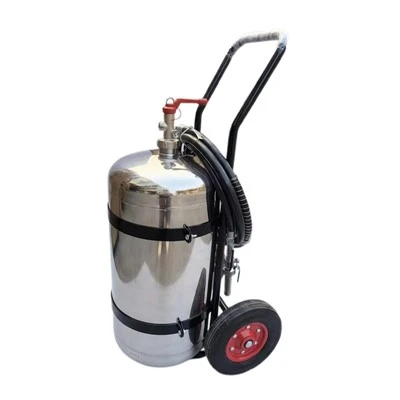
First, let’s get on the same page about what we’re dealing with here. Trolley fire extinguishers are the big guys—think 50L ABC dry chemical, foam, or CO2 units that take two people to roll around, not the tiny 2kg ones under your kitchen sink. We sell these because, let’s be real, a small extinguisher can’t take down a warehouse fire that’s eating through pallets of cardboard or a printing press spewing ink fumes. They’re built for high-volume, large-area fires, which is where most industrial or large-site fires get tricky. But here’s the thing: they don’t work in a silo. No piece of fire gear does, really.
Let’s start with the most obvious compatible sidekicks: hand-held fire extinguishers. Wait, why would you need both? Most facilities I work with have trolleys for the main risks—like a loading dock with flammable liquids or a server room—plus hand-held units for quick, small fires. The key here is matching the agent. If your trolley is ABC dry chemical (works on solid, liquid, and gas fires), your hand-helds should be the same. I see so many sites mix and match: a 50kg ABC trolley next to CO2 hand-helds for the same zone, and that’s a mistake. Why? Because when the fire department shows up, they’re going to coordinate all your gear, and if the agents don’t line up, that’s wasted time. For example, a CO2 extinguisher is great for electrical fires (it leaves no residue, so you don’t mess up servers), but an ABC dry chemical trolley is better for an electrical fire that’s spread to nearby packaging. If your trolley is CO2, you might not have enough coverage. I always tell clients: map your high-risk zones first, pick the trolley agent for each zone’s biggest threat, then match hand-helds to that. It’s not rocket science, but it’s the difference between a fire that’s contained in 10 minutes and one that takes 2 hours.
Next up: fire alarms and suppression systems. This is where I’ve seen most small to mid-sized facilities mess up the compatibility thing. Modern fire alarm systems are linked to every piece of safety gear, right? So when the heat sensor goes off, it should trigger your sprinklers, but also, could it trigger your trolley extinguishers? Wait, not directly—but you can rig them to work in sync. For example, if you have a commercial kitchen with a deep fryer fire risk, your trolley foam extinguisher (made for cooking oil fires) can be connected to the kitchen’s fire suppression system so that when the hood sprinklers go off, someone gets an alert, and they know to grab the matching trolley. Another example: server rooms with clean agent suppression. Those systems usually shut down once the fire is out, but if the residual embers spark again, your CO2 trolley (which doesn’t leave gunk) is perfect to follow up with. I’ve had clients test this at our training demos: set up a small server room fire, trigger the clean agent system, then have the team roll up the CO2 trolley to put the remaining heat spots out. No conflict, no issues—just backup that actually works.
But wait, what about the big one: fire department gear. This is non-negotiable. Trolley extinguishers are built to be compatible with standard fire hoses, nozzles, and even thermal imaging cameras (the ones firefighters use to see through smoke). Wait, let me explain that. When firefighters show up, they’re going to assess the scene, and if your trolleys are labeled correctly with the agent and fire class, they’ll grab them to supplement their own gear. I worked with a factory in Detroit a couple years back where a pallet of plastic caught fire. The local fire crew showed up with their hose lines, but the ABC trolley the factory had was right by the loading dock, easy to roll in, and gave them extra coverage. They said it worked way better than hauling their own smaller units over. But here’s a caveat: compatibility with fire department gear isn’t just about the unit—it’s about the labels. If your trolley’s label is faded, or it just says “trolley extinguisher” with no agent or fire class, firefighters won’t touch it. That’s a huge mistake. We always make sure the units we sell have bold, clear labels, and we tell clients to do monthly checks to keep them readable. If your labels are gone, just re-stick them—no cost, saves lives.
Now, let’s talk about the myths that bug me the most. I hear all the time: “Trolleys don’t work with water mist systems” or “You can’t use a foam trolley if you have a pre-action sprinkler system.” That’s 100% not true. Water mist systems are designed for small, hot fires, but if a fire spreads beyond their range, your trolley can be used safely alongside them. I’ve tested this at our training yard: set up a wood pallet fire, trigger the water mist, then when the fire gets bigger, roll up the ABC dry chemical trolley. No splashing, no electrical issues, just a controlled knock down. Pre-action sprinkler systems (the ones that only go off if heat is detected, not smoke) work with foam trolleys too—you just have to make sure the foam agent is rated for the temperature range of the sprinkler heads. Most of the top trolley brands (and the ones we sell) have foam units that work with standard pre-action systems, so it’s just a quick check on the specs.
Wait, but what about when it goes wrong? Let’s be real, there are times you might have compatibility issues. The number one mistake I see is mismatched fire classes. For example, a CO2 trolley for a Class B liquid fire (gasoline, oil) next to an ABC dry chemical trolley for the same zone. No, wait—actually, that’s not the problem. The problem is using a water-based trolley for an electrical fire. Water conducts electricity, so if you roll a water trolley to a live electrical fire, you’re putting everyone at risk. That’s a compatibility issue, but it’s user error, not the gear itself. Another one: overloading a site with different agents. If you have three trolleys in one zone: ABC, foam, CO2. You don’t need that. It’s confusing for your staff, and when a fire hits, they’ll grab the wrong one. We do a free site assessment for all our clients—seriously, no sales pitch, just a quick walkthrough—to help them avoid that. Last year, a small grocery store in Chicago called us because they had a water trolley by the deli’s deep fryer, which is a Class K cooking oil fire. We told them to swap it for a Class K foam trolley, and now it works with their existing deep fryer suppression system—no conflicts, no risk.
Let’s circle back to why this actually matters for you, not just for a fire demo. I’ve seen sites skip this compatibility stuff, and the result is always bad. A construction site in Cleveland a few years back had a gas fire that spread to some wooden scaffolding. They had a CO2 trolley (great for gas) but their hand-helds were water-based. When the firefighter rolled the trolley up, the water hand-helds confused the team—they didn’t know if they should use the CO2, or try the water, which could’ve made the fire worse. It took them an extra 12 minutes to figure it out, and the scaffolding burned down. That’s avoidable. If they’d just made their hand-helds match the trolley’s agent, that time would’ve been cut in half.
So, what’s the takeaway here? Trolley fire extinguishers are super compatible with most standard fire-fighting gear, as long as you do three simple things: 1) Match the agent to the fire class of your zone, 2) Keep labels clear so everyone (including firefighters) knows what’s in them, 3) Don’t overdo it with conflicting units. If you’re unsure, just hit up someone who knows trolleys (ahem, like us) and ask for a quick check. We don’t push sales—we’ve had so many clients call us later to say that because we pointed out a compatibility gap, they avoided a huge issue.
Look, I’ve been in this game long enough to know that fire safety isn’t just about having gear—it’s about gear that works with each other. Trolleys are a big investment, but when they play nice with your hand-helds, alarms, and the local fire department, they’re worth every penny. If you’re in the market for new trolleys, or you want to run a quick check to make sure your current ones work with the rest of your setup, just reach out. We can walk you through it, no pressure, no fine print. Stay safe out there.
Emergency Fire Blanket References:
- National Fire Protection Association. (2022). Standard for Portable Fire Extinguishers (NFPA 10).
- Occupational Safety and Health Administration. (2021). Fire Protection and Prevention (OSHA 1910.157).
- American National Standards Institute. (2020). Standard for Wheeled Fire Extinguishers (ANSI/UL 626).
Shaoxing Weimin Fire Fighting Equipment Co., Ltd.
Shaoxing Weimin Fire Fighting Equipment Co., Ltd. is one of the most professional trolley fire extinguishers manufacturers and suppliers in China, also supports customized service with low price. Welcome to buy discount trolley fire extinguishers in stock here and get quotation from our factory. 5 years warranty is available.
Address: CHINA
E-mail: info@weiminfire.com
WebSite: https://www.weiminfire.com/
